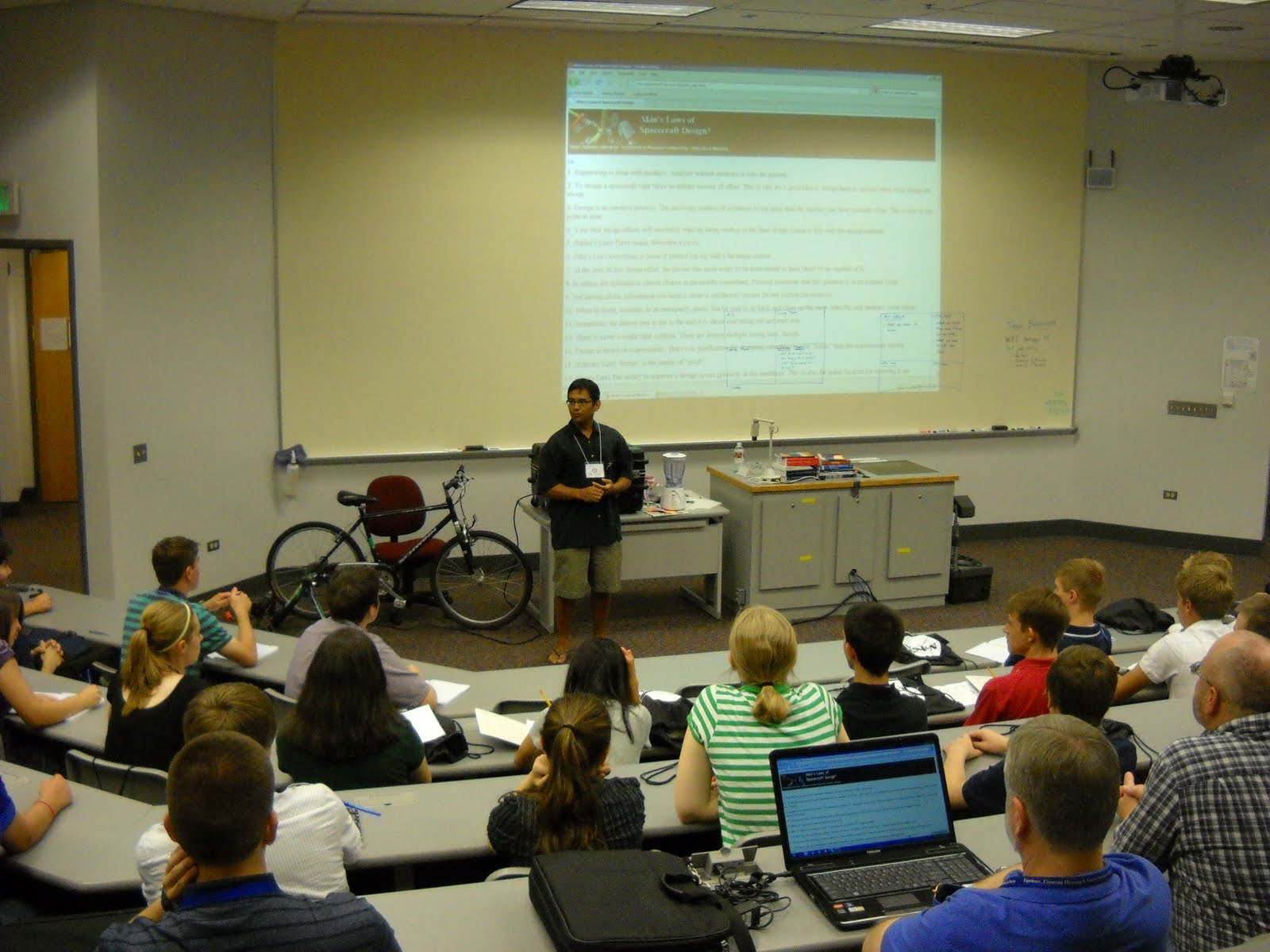
Wednesday, July 20, 2011

ISAS 2011 Academy 1 Day 3: Ames Research Center

Today began earlier than normal for all the students and staff of ISAS as they geared up for the much anticipated trip to San Jose, CA, to visit NASA Ames Research Center in the Silicon Valley. Getting through the security checkpoint at the Boise Airport (BOI) was a smoother transition than anticipated, given the size of the group, and all students were able to rendezvous with their groups and locate the respective departure gate on time.


Students headed to San Jose

After a relatively short flight, the students and staff arrived at the San Jose International Airport (SJC) and immediately headed towards the coach bus that was waiting at the bus stop in front of the airport. The students stayed at Navy Lodge, and each student departed the bus in an orderly fashion, took their belongings and awaited their turn to drop off their suitcases and begin exploring Ames Research Center. As the students headed to the visitors center, they were able to steal their first glimpses of the center through the security gates.

The students started the visit at the Ames Visitor Center, where the students were able to view different displays such as moon rocks brought to Earth by Apollo 11 and an interactive lecture on the universe. Other students, as well as staff, were in the gift shop buying items both for themselves and for their family members back home.

After the students had viewed all of the exhibits, both students and staff were guided into Ames by Tom Clausen, Director of Education, and arrived at the cafeteria on the base; MegaBites. The students were able to luncheon amongst soldiers and NASA scientists and even visit a secondary gift shop.

Directly after lunch, the students were divided into two groups, Blue Team and White Team comprised Group A while Red Team and Gray Team comprised Group B. Each group headed towards two separate buildings: the Crew Vehicle Systems Research Facility and the Fluid Mechanics Lab. In the Fluids Lab, the students were guided by undergraduate interns and shown two different wind tunnels. These wind tunnels have even earned some fame on an international scale. These tunnels have been used to test the regulation World Cup soccer balls as well as model vehicles from the popular show Mythbusters. The students were even allowed to place small plastic hoses into the tunnels to listen to the different sounds produced by the air vibrations. In another laboratory, the students were shown a small model car submerged in water with a colorful dye, allowing observation of wake and drag acting on the car.


Students entering the Fluid Mechanics Lab

In the CVSRF the students were allowed to enter two different flight simulators used by NASA to study how pilots operate while flying. The students thoroughly enjoyed not only going into these simulators but seeing them in action while “flying” around the Bay Area. Students and NASA directors smiled and chatted happily as the students had the opportunity to experience what very few individuals are even allowed to see, let alone touch.

Afterwards, the students were taken to a different building were they met Natalie Batalha from San Jose State University. Natalie lectured the students on the Kepler telescope project and its mission of searching for other Earth-sized planets outside of our solar system. Many students, and staff, had great questions about the use of the Doppler Effect in order to search for planets and whether said planets were gaseous or solid. In fact, so great were the questions that Natalie decided against narrating the flyover about the planet Kepler-10 and let the students decipher what they were viewing. The students were exceptionally happy to be given the opportunity to feel involved with a true NASA project.

The next stops for the students were the Centrifuge and Vertical Motion Range. In the centrifuge, the students were briefly lectured on some of the functions of the centrifuge and how it has been used for various films ranging from Hollywood films to History and Discovery Channel documentaries. After the lecture, the students were allowed to go into the centrifuge room and take pictures, look into the capsules, and even take team photos in front of the NASA logo.


Exploring the centrifuge

At the Vertical Motion Range, the students were able to see an actual simulation of a shuttle landing. They learned about how the simulation was able to function and reproduce the same g-forces on those inside the simulator without the actual craft taking off. After the simulation was over, the students were able to go into some of the simulation capsules that were being prepped in the warehouse and roam around the small rooms were many astronauts test their shuttle landing skills.


It was a long, exciting day

At the end of the day the students came back happy and tired, ready to dive into the delicious plates of lasagna and salad provided by the staff. After getting their fill of the delicious Italian dish, the students were given free time and enjoyed it thoroughly until bed time.

These blogs will continue to be uploaded daily, once the students have completed their final activities each night. A more "live" version of the days' events are being uploaded onto the ISAS Summer Academy Facebook group and page, as well as to Twitter at ISAS_Academy. The students are eager to continue exploring Ames Research Center and have another busy day ahead of them.


 -- Jaime Guevara, Andrew Schrader --

Monday, July 18, 2011

ISAS 2011 Academy 1 Day 2

The students’ day began with a trip to the Simplot/Micron building at Boise State University, where they partook in a video conference with Alan Ladwig from NASA’s headquarters. Alan discussed the importance of space exploration not only to NASA, but also to the technological advancements consumers enjoy every day. Alan showed the students new concept vehicles for future missions. He also discussed the new expectations of the American public concerning space exploration and budget cuts from Congress that would push NASA to look for more economical ways to carry out their missions. Students also were surprised to learn about the newest influence of private sector companies on space travel. When given the opportunity, students gladly asked questions concerning the future of space exploration as well as asking for tips for their missions here at ISAS and for their futures.

The students then traversed across campus to the Boise State Engineering Building in order to listen to Jason Budinoff, an Aerospace Engineer from NASA Goddard Space Flight Center. He discussed with the students what responsibilities would be expected from the four different teams. These four teams (Red, Gray, Blue, and White) split up the Mars mission into four separate arenas: Mission Integration, Getting There, Living There, and Working There. The students became more lively and inquisitive upon hearing what was going to be required of them throughout the next week.

Jason Budinoff talking with students

The guidelines for their mission were purposefully vague: Go to the Poles (on Mars), Stay for 30 days, and Come back. Jason Budinoff challenged the students to debate the question, “How do we change this vague idea into a full-blown mission?” After discussion, the students split up into teams to debate further the goals of their teams and to develop the mission outline into a detailed mission plan. They then grouped back together, and presented their research to the entire Academy. They also had the opportunity to share their findings with Jason Budinoff where he was able to critique their work.

Landon Browning presenting ideas

After a short break for lunch, the students returned to the Boise State Engineering Buildings to hear from the Boise State Engineering Dean, Dr. Amy Moll. She spoke about Boise State University, and the College of Engineering. The students were encouraged to ask questions about different types of degrees & minors offered at the College of Engineering. She stressed to the students that their ideal college, should be a perfect fit for their education style, and should fit their needs.

Students then split to work in their teams even further in order to meet their deadlines. After working for an hour, the students were then able to listen to a presentation about rockets by Corey Morasch from Micron and another presentation from Boise State University’s own Microgravity University Team. Both presentations helped the students gain a stronger understanding of the limitations of trying to reach space and what is necessary to remain in space. All the students were fascinated by the 12 foot rocket in the corner of the room and the stories from the Microgravity Team from their ride in the Zero G plane, affectionately known as the “Vomit Comet”.

Later in the evening, the students were also visited by Woody Sobey From the Discovery Center of Idaho. He educated the students about what is and is not a robot and how to create an autonomous system. Being such a complicated system, Woody let the students know that they were about to cram a week’s worth of material into about a three hour time slot. The students immediately rolled up their sleeves and dived into working on the robots. Many different students took charge and displayed impressive leadership skills when organizing the robots. They all impressively worked hard to make their robots listen to different programs and follow a rigid set of instructions

Students building their robot

By the end of the long day, the students had already gelled as a functioning mission control. The students even began to express how well the teams were coming together.

"We already work together really well."
-- Erika Isom

With the day winding down, the students began to prepare themselves for the exciting trip to NASA Ames Research Center during day three and four of the ISAS Summer Academy. These blogs will continue to be uploaded daily, once the students have completed their final activities each night. A more "live" version of the days' events are being uploaded onto the ISAS Summer Academy Facebook group and page, as well as to Twitter at ISAS_Academy. The students have established themselves as mission control and are now ready for the trip to Ames Research Center.

--Andrew Schrader, Jaime Guevara, LaCinda Villanueva--

Sunday, July 17, 2011

ISAS 2011 Academy 1 Day 1


Welcome to the 2011 Idaho Science and Aerospace Scholars Summer Academy blog and media channel. These daily blogs will be posted on the Department of Education website, keeping parents, students, and others informed about the program's activities. The blogs are written by the three following individuals.

My name is Andrew Schrader and I am one of the bloggers for the ISAS summer program. I recently completed my freshman year at Valparaiso University with an intended major in Mechanical Engineering. Two years ago I interned at NASA Ames Research Center with the NASA INSPIRE program. I am happy to be a part of the newest ISAS Summer Academy and can't wait to be involved.

My name is Jaime Guevara; I am also a blogger for the ISAS program and am attending Boise State in the fall and like my co-blogger will be continuing my studies in Mechanical Engineering. I am happy to continue being one of the first bloggers for the ISAS Summer Academy and hope that parents will be pleased, not just with the daily blogs, but with the program their children are involved with during this key week in their lives.

My name is LaCinda Villanueva. I am an intern helping with the blogs and am currently attending the College of Western Idaho. I plan on transferring to the University of Idaho for a degree in Chemistry. I attended ISAS last year as a student and I enjoyed every aspect of it. I am excited to be back, and to be helping with the blogs.

The Idaho Science and Aerospace Scholars Summer Academy is a weeklong academic workshop that engages and challenges high school juniors to utilize the knowledge they have gained in their classrooms and apply this knowledge in real life scenarios. The students, while residing and working out of Boise State University, will also undertake a trip to NASA Ames Research Center in Mountain View, California where they will be exposed to the many different STEM (Science, Technology, Engineering, and Mathematics) careers available to them. While partaking in activities that encourage thought and problem solving skills, the students will also have the opportunity to interact with scientists working in their field on real life projects.

 As noon approached on the first day of the academy, the newest 2011 ISAS Summer Academy students began to arrive at Boise State University and settle into their dorms. Students were given the time to place their belongings in their rooms and interact with the every-growing number of students. Many of the students recognized one another from similar schools or hometowns, but many students had the opportunity to meet with others from all parts of Idaho. The students spent some time mingling in the lobby of the dorm, talking excitedly with one another, and very anxious to begin.

 
Students mingling
 By 2:00 PM, the students had checked into the Academy and were led by their mentors and Director Peter Kavouras to The Discovery Center of Idaho. Here, the students were able to mingle further and had an opportunity to experience many of the different exhibits the center had to offer. Some students even shared what they were excited about.


"We wanted to take part in ISAS because we love engineering and space"
--Evan Lovel

After spending time throughout the center, the students congregated into the front room to disperse into their separate teams: Gray, Red, White, and Blue. The teams discussed the Academy rules and chose team leaders. In order to encourage the students to interact outside of their teams, nametags were passed out randomly, requiring the students to become better acquainted with one another. Students laughed as they introduced one another and clearly began to come together as a stronger unit. They will definitely need that cohesion in order to successfully design a manned-mission to Mars.

 
Students being briefed in Discovery Center of Idaho

After a quick meal, the four separate teams, each one representing a different aspect of the mission, presented a patch/logo for their team which they had designed. Students had been communicating previously through the internet program in order to present their creative ideas on this first day.

The final event of the night was a project called the "Table Tennis Triathlon". For this project, the students had to use supplies given to them to create simple machines to perform the functions of a catapult, cantilever, and rocket. Each of these different machines must carry with it a table tennis ball and at the same time fulfill certain requirements. Each event was scored and the team with the greatest overall score was declared the winner.
 
Blue Team Strategizing
 Overall, the first day of the new Idaho Science and Aerospace Scholars Summer Academy was very successful, engaging, and fun for students and mentors alike. These blogs will be uploaded daily, and once the students have completed their final activities every night. A more "live" version of the days' events are being uploaded onto the ISAS: Idaho Science and Aerospace Scholars' facebook page. The students have had the chance to meet, and greet with their peers, and are now ready for the oncoming events of the week.


-- Andrew Schrader, Jaime Guevara, LaCinda Villanueva--


Thursday, July 14, 2011

Idaho Students to Study with NASA Experts this Summer

Nearly 90 Idaho students will spend part of their summer break studying space exploration with NASA officials and Idaho experts in science, technology, engineering and mathematics (STEM). These students are part of the second annual Idaho Science and Aerospace Scholars Program Summer Academy.

In 2009, Superintendent of Public Instruction Tom Luna worked with astronaut and Boise State Distinguished Educator-in-Residence Barbara Morgan to create this competitive program that allows Idaho high school juniors to take an engaging online course developed by NASA during the school year and then compete for the opportunity to work on developing a mission to Mars with NASA and Idaho scientists.

“The Idaho Science and Aerospace Scholars Program is an unprecedented opportunity for our high school students to work side-by-side with experts in the fields of science, technology, engineering and mathematics from across the state of Idaho and at NASA. We are grateful to partner with NASA, Boise State and other Idaho organizations this year to continue this exciting program,” Superintendent Luna said. 

“Engaging the next generation in research and opening their eyes to the possibilities of STEM are priorities at Boise State, and this program is an outstanding extension of our mission,” Morgan said. “We are delighted to be collaborating with all of the great organizations and dedicated people who make this wonderful program possible.”

In its first year, 73 students enrolled in the online course, and 44 students went on to the Summer Academy.  The program was expanded this year, with the help of a $939,457 in grant funding from NASA. This year, 134 students enrolled in the online course, and 88 students will be participating in the Summer Academy, which will be held twice.

Forty-four students will attend the first Summer Academy July 17-23, and 44 students will attend the second Summer Academy July 31-August 6.

The weeklong summer Academy takes place partly at Boise State, Micron Technology and the Discovery Center of Idaho, and partly at the NASA Ames Research Center in California. At the Summer Academy, students are immersed in a NASA mission, a problem-based engineering design challenge. STEM experts, teachers and mentors will guide these Idaho students as they design a human mission to Mars.

The Education Idaho blog will provide live updates of the week’s events during both Summer Academies.

Tuesday, July 12, 2011

Idaho Schools Will Receive $60M in Additional Funds

Idaho’s public schools will receive an additional $60 million in state funding this year, Governor C.L. "Butch" Otter announced today.

"This is a great day for Idaho schools," Superintendent of Public Instruction Tom Luna said. "I thank the Legislature and Governor Otter for their fiscally responsible approach to budgeting and continued commitment that Idaho public schools will receive the first dollars available. Now, we are able to distribute $60 million in additional funds to our schools, which will more than cover the $47 million shortfall school districts were going to face in the upcoming year."

The additional funding will be distributed to public schools through discretionary funds.

Read Governor Otter’s full statement on the additional revenues statewide.

Monday, July 11, 2011

School Net and Discovery Learning Presentations

Led by Jason Martinez, several members of the Denver Public School system spoke to the Technology Task Force today about the success they have enjoyed in implementing their Instructional Management System. SchoolNet, a program Idaho is soon to employ thanks to a generous donation by the J.A. and Kathryn Albertson Foundation, gives classroom teachers and school administrators the data they need to guide instruction and raise student achievement.


Wuanita Vann, a high school teacher from Denver who described herself as data-averse, spoke enthusiastically about how the data system won her over. Because she can access student data more quickly, she is much better able to serve her student population. This is especially true for at-risk students. She can now get information before or shortly after students arrive in her classroom—not months or sometimes a semester later, as it worked in the past. The system also allows her to plan interventions and collaborate with other teachers to develop individualized learning strategies for students who need remediation. SchoolNet allows her to more efficiently locate problems so she can spend more time developing solutions.

“I get the whole picture of a student,” said Wuanita. “It’s like Gatorade for teachers…It really has revolutionized the way we work.”

The team from Denver did a good job explaining how online data could benefit school systems and teachers; Hall Davidson, from Discovery Learning, showed how his company could further augment this online data bank.

Not only can teachers access student information, state content standards, curriculum and online assessments, Discovery Learning also has worked with SchoolNet to provide digital content that teachers can incorporate in their classrooms. The digital content and multimedia further enhance classroom learning and engage a new generation of students who are accustomed to assimilating information from media. Whether it is engaging video or interactive media opportunities that inspire student creativity, Discovery Learning represents a serious online resource for teachers.

Technology Task Force - Steven Garton of Maine Learning Technology Initiative

Steven Garton of the Maine Learning Technology Initiative met with the Technology Task Force this morning via web video to deliver his insights gleaned from ten years of successful laptop implementation in Maine schools. Much of his presentation highlighted not only the benefits of technology in the classroom, but the benefits of allowing students to fully embrace and take ownership of that technology.


Key to the success of any program, said Garton, is a very thorough and well-considered plan. A clear idea of tech goals for the classroom, proper negotiation of laptop plans, and even consideration of how students will store and transport their devices all contribute to a more successful tech implementation.

Professional development and teacher participation were central features of Garton’s presentation; he repeatedly emphasized the need for teachers to have the skills and training they need to meaningfully integrate laptop use in the classroom. When students see that teachers take the technology seriously and respect the devices, they have a tendency to do the same.

Most interesting, perhaps, was Garton’s suggestion that allowing students to take ownership of their machines led to greater learning and reduced damage. When students were allowed to take their machines home and use them for personal purposes, they could see the benefit of taking care of them. Last year, Maine had a breakage rate of less than 2%.