Saturday, July 14, 2012

ISAS 2012 Academy 1: Final Day


Today the first Idaho Science and Aerospace Scholars of 2012 came to a close as students, parents, mentors and honored guests attended a VIP luncheon in Boise State University’s Student Union Simplot Ballroom. In order to prepare this morning for the luncheon, the students practiced their presentations and filled out surveys which would better the program for future years. The students were found themselves caught among different emotions as the day progressed: excitement to see family, anxiety to speak publicly, and a nagging disappointment to leave behind so many new friends so soon.

A look back at the beginning of the week and the students' first project: the egg "carriers"
 As observers of the students throughout the week, it was amazing to watch a group of high-schoolers from across an entire state gel so quickly and design an original mission to Mars, all while experiencing countless different STEM (Science, Technology, Engineering, and Mathematics) opportunities. What these students have achieved in the past week is astounding. Idaho is truly fortunate to be one of only five states to take part in the High School Aerospace Scholars program. The state is also exceptionally lucky to have such amazing students within its borders. With students like these earning these experiences, Idaho has a bright future indeed.
The students received the opportunity to tour NASA Ames Research center
 Later in the day, the students walked to the union one last time wearing their respective team colors and chatting excitedly to one another. When the luncheon began, students mingled with parents and met the relatives of their new friends as well as special guests. The luncheon opened with an address by ISAS director Peter Kavouras and the reading of a letter from Governor Butch Otter addressed to the ISAS program.

After hearing what the governor wished to say to the students, all those in attendance ate delicious pasta and chicken with all sorts of sides. The ballroom filled with the sounds of clinking silverware, conversation, and music as a commemorative video of the 2011 Academy played on a screen in the background. Once the meal was completed, each team stepped up to the stage in order to present their respective components of the mission accompanied by a PowerPoint presentation. The parents listened carefully and in some amazement. Here in front of them were their high school children, the same children who were dropped off at Boise State University one week ago, presenting revolutionary ideas as professionals. To witness such an event, parents could not help but feel proud as their children displayed a striking maturity and air of success, uncommon in the typical high school student. 

The luncheon continued with addresses by Dr. Tony Roark and Dr. Art Johnson. Both emphasized just how important this program has been to the students, and the positive impact it has had on all of their lives. Dr. Johnson’s address left the students hollering a boisterous ‘hoorah’ as they answered his many impromptu questions concerning what the program has done for the students. 

The luncheon came to a close with the presentation of diplomas and prepared speeches by a few of the students who were adamant in sharing their experiences with all those present. Some even brought tears to his, and the audience's eyes. 


This week was very memorable for both students and mentors alike
With ISAS 2012 Academy 2 preparing to start in two weeks, many of those involved with the program are excited to witness another class like this past one pass through the Academy. On behalf of the Department of Education and the entire State of Idaho, we would like to congratulate ISAS 2012 Academy.
  
This last blog concludes the coverage for Academy 1. Starting on Sunday, July 22, the blogs for Academy 2 will begin. The blogs will be uploaded daily, once the students have completed their final activities each night. A more "live" version of the days' events are being uploaded onto the ISAS Summer Academy Facebook group and page, as well as to Twitter at #ISAS_Academy. Tomorrow will be the students' last day of the program. All of the staff at ISAS wish them good luck and are proud of all the work they have done. 


--Jaime Guevara, Heidi Hughes--


Friday, July 13, 2012

IDAHO TO HOST NATION’S TOP EDUCATION LEADERS


 Idaho will host the nation’s top education leaders next week as the Council of Chief State School Officers (CCSSO) kicks off its Summer Institute on Saturday evening in Coeur d’Alene.

Superintendent of Public Instruction Tom Luna currently serves as President of CCSSO. CCSSO is a nonpartisan, nationwide, nonprofit organization of public officials who head departments of elementary and secondary education in the states, the District of Columbia, the Department of Defense Education Activity, and five U.S. extra-state jurisdictions. CCSSO provides leadership, advocacy, and technical assistance on major educational issues.

“As many states work to reform public education for all students, Idaho has been on the forefront. I am excited to host these top education leaders in our great state over the next few days,” Superintendent Luna said. “The Summer Institute is always a great time for state chiefs to work together on how we as states will take the lead on critical issues and policies facing our nation today.”

CCSSO’s 2012 Summer Institute is scheduled July 14-17. It will focus on resourcing innovation. While the U.S. economy struggles to pull itself out of a recession, our public education system continues to institute major reforms that will help students prepare for postsecondary education and career. Tight budgets and a lack of resources are a reality that all states face.

The Summer Institute will open with a keynote address from author and columnist Matt Miller. Well-versed in issues of finance and innovation, Miller will speak about the inherent competition between education and other public services for resources and funding.

The agenda also will feature sessions focused on key reform issues such as teacher preparation and evaluation, standards and assessment implementation, and learning innovations, in the context of funding and budgets. How can we elevate the teaching profession in this country and support teachers throughout their career? What are realistic budget considerations when it comes to new assessment systems and standards implementation? What are alternative sources of funding that can be of service to states? Participants will hear from experts and practitioners about the implications of these reforms. The funding lens will be used to engage chiefs and deputies in frank, honest conversation about the future of education funding and innovation.

Superintendent Luna will kick off the conference on Saturday evening. On Sunday, he will introduce a panel discussion on teacher preparation and evaluation and participate in a panel discussion on how state education agencies can actively engage legislative leaders. Idaho State Senator John Goedde and State Representative Bob Nonini will also participate in this panel discussion.

For more information on CCSSO, visit www.ccsso.org.

Thursday, July 12, 2012

ISAS 2012 Academy 1: Day 5


After returning from NASA Ames Research Center, the students were able to rest for a little while before continuing to visit more places. With a quick and early breakfast, the students piled into a coach which took them to Micron Technology for a day of exploration around a worldwide manufacturer of electronic goods. For those who do not know, Micron specializes in creating revolutionary memory units for computers and other devices. As the students were led into the factory, they were brought into a small conference room. While in the room, the students were shown a slide show and video detailing the products and applications of the memory units manufactured by Micron. 

Following the introductory videos, the students were taken to the new addition to the research and development fabrication area. Here the students were shown how Micron, and other companies like it, stay a step ahead of their competition by implementing various scientific and mathematical  methods not just for reducing costs but even to something as rudimentary as the building itself. The students were able to view the new fabrication rooms and were asked to try and put into perspective what Micron was trying to achieve here, by being able to look at the loading robots and even the gas pipes the students were humbled by the thought that something already big was small in comparison to the end goal: put the knowledge from the R&D fab into an actual production line five to ten times bigger. 

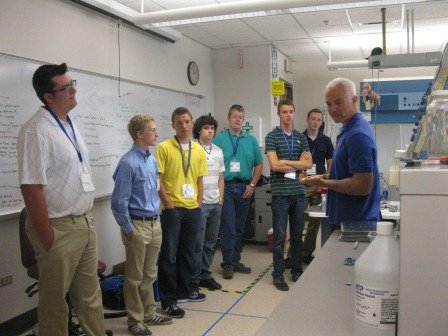
When the students were done touring the brand new building on Micron's campus, they were taken to the older main building and separated into groups in order to tour the various analysis labs that Micron has on its Boise campus. These labs showcased a wide range of analytical processes that Micron employs such as chemical analysis and even electron spectroscopy. The students were able to see that in order to even make a huge company focused on memory chips and processors work, all sorts of different fields such as math, science, and even public relations are necessary.

Even after their days at NASA Ames the students are still happy to hold up rockets
Upon completing the visit to Micron, the students were taken to Simplot Fields in order to witness a rocket being launched. After spending a good portion of the day inside Micron, the students were visibly refreshed by the sunlight and fresh air, regardless of the heat and smell of smoke from the fires near Boise. The students hiked across the grass of the field, carrying several of the rockets. The stands were set up and the first rocket was set up. Before its launch, though, everyone noticed a couple new people. The media company that was hired to film the events of the two sessions showed up for their first day at work, equipped with cameras and a boom microphone. This only helped fuel the excitement for the rockets. The button was pressed and the first rocked zoomed to the sky leaving students shielding their eyes and following the screaming rocket as it ascended higher and higher. Upon reaching its zenith, the rocket plummeted back towards the crowd of students until its parachute deployed. The students erupted in cheers as the rocket slowly floated back down and landed only a few hundred feet away. The students then loaded back into the bus, happy to be back into the air conditioning, and headed back to Boise State. They spent the following two hours working even harder on their projects. Then dinner followed.  

Even with a beautiful take-off, this rocket showed the students that just as important as checking the take-off is checking the landing equipment

 At the end of the academic day, Wendy A. Lawrence, former NASA astronaut, did an interactive discussion with the students. Coming prepared with a PowerPoint, and her more than ample knowledge of space travel and how to approach a trip to Mars. After giving a brief history of her experiences, she dived directly into the topic. The main focus of the night was several different areas that she warned students to take account of when planning their trips to Mars. These problems are ones that have been impacting astronauts on the International Space Station. Those issues included: radiation, bone density loss, solar flares and vision loss. After addressing these concerns, she turned it over to the students to ask questions. Almost all of the questions directly pertained to the research that the students have been doing over the past few days. However, many students asked questions of curiosity, “What's your favorite part of being an astronaut?” One student asked. “The take off,” she said, “It seems trite, but it's quite a kick in the pants.” A bit later another student asked, “What do you do for fun in the International Space Station?” With a quick and exciting retort of, “We're weight-less!” All in all, for the academics portion of the day, today was rather successful; however it didn't mark the end. 

NASA astronaut, Wendy Lawrence, teaching the students on the valuable topic of the psychological and physical effects of space travel on people

The students were finally able to let off some steam and relax with a good few rounds of bowling and billiards in the Student Union Building. For the first time all session the students were given extra time to just play around, relax and have some scheduled free time to socialize and have a blast.

These blogs will continue to be uploaded daily, once the students have completed their final activities each night. A more "live" version of the days' events are being uploaded onto the ISAS Summer Academy Facebook group and page, as well as to Twitter at #ISAS_Academy. The students are eager to continue work on their missions as they prepare for the last day of work on their mission and presentations.
--Heidi Hughes and Jaime Guevara--


Wednesday, July 11, 2012

ISAS 2012 Academy 1: Day 4

Today marked day four for the Idaho Science and Aerospace Scholar Program. After yesterday's full day of an early start, plane flight, and hikes across NASA Ames Research Center in order to learn from scientists, students shuffled down the hotel halls to the continental breakfast. They scooped up their eggs, sausage and other eateries and slumped into the chairs, however, after leaving the hotel and taking a brisk walk against the Bay Area air, the students were awake and ready for the very first part of their NASA day, a lecture from Chris McKay, NASA space scientist. 

"There are three things to consider when considering missions to Mars", Dr. McKay began his speech to the students, "those are the past, present and future". The lecture continued for an hour in one of NASA Ames' auditoriums. Topics discussed included: the importance of studying Mars, it's possibility -- or maybe even lack thereof -- to one day become a human habitable planet, current Mars missions and explorations, and what the theorized and potential history of the "Red Planet" may have been like if it might have once supported life. Intertwined between these topics, students were able to approach Chris McKay with questions about their mission projects and their aspect of the manned Mars mission. In his NASA Ames's biography he explains, "My research focuses on the evolution of the solar system and the origin of life. I'm also actively involved in planning for future Mars missions including human exploration." Indeed, after his lesson today, the students were able to better understand how great his expertise on their topic of study is. 

The teams were then able to split up in their normal combinations--green with white and red with blue--to see the Mars Wind Tunnel and the Psychoanalytical Lab. The wind tunnel group began by meeting up with another NASA scientist who explained the concept of this smaller wind tunnel. This wind tunnel is located inside of the Tower Test Chamber. When testing a model vehicle of something that would be used on Mars, the model would be placed in the wind tunnel, with various kinds of dust, then the pressure in the Tower Test Chamber would be set to that of Mars, and the wind chamber would start, blowing the dust. This experiment allows the scientists and engineers to see how Mars' atmospheric pressure mixed with the dust would impact, and possibly harm, the equipment if really used on the planet. Students were able to look through the wind tunnel and see what kind of special dust mixture is regularly used. 

Over in the Psychoanalytical Lab students got to hear about a NASA developed treatment, now licensed to another company on how to help astronauts who struggle with a different kind of motion sickness. Motion sickness in space, while exhibited the same way, is worse and slightly different than that demonstrated on people here on Earth. The students were able to hear about a form of treatment that almost always helped alleviate this issue, not only in astronauts experiencing motion sickness, but in people with severe inner ear problems, anxiety, and other problems of the sort where controlling one's symptoms is helpful. "The point of this treatment," the research psychologist, Dr. William B. Toscano said, "isn't to get rid of the problem. We don't know how to do that yet. It's to help suppress the symptoms". The students watched a movie showing some of the treatments and were able to ask a few questions. 

With half of their day completed, it was now time for a burrito lunch in Mega Bites, the Ames cafeteria, and a last time to purchase from the gift shop before heading out to the next venue.

Brian Day was the next speaker. Lecturing in the same auditorium the students were in this morning for Dr. McKay's time, the students now got to hear about the moon and the current scientific understandings of it, as well as its dichotomy to what was once understood. Within his time, he discussed the origins of the moon. Other things discussed included the moon's water content and newly discovered atmosphere. This served to probably give the students some insight as to a possible use of the moon as a sort of "checkpoint" for future Mars missions, if they so chose.

Following Brian Day's lecture, the students were taken to the flight simulator. Here the flight simulation allowed students to enter an area known as the “cab” and sit in seats identical to that of popular Boeing planes. Students were allowed to take off, land, and fly the “plane” through the great San Francisco bay. Some students even attempted to fly the simulation under the Golden Gate Bridge. The programming of the simulation was so realistic most students confessed they really felt like or even thought they were moving.

The concluding activity of the day was the much anticipated, and somewhat famous, Fluid Dynamics Lab. This lab contains several smaller wind tunnels, similar to the one that students were able to walk inside of yesterday, as well as a small water channel. The majority of these tools have been used by the popular television show on the Discovery channel, MythBusters. The primary use for the wind tunnels, however, is to simulate the air currents around an aircraft in flight by using scaled models. The NASA Glenn website describes the function of a wind tunnel as the following, “In the wind tunnel, the aeronautical engineer can control the conditions that affect the forces and motion of the aircraft. By making careful measurements of the forces on a model of the aircraft. the engineer can determine the magnitude of the forces on the real, full-size aircraft. The wind tunnel model can also be used for diagnostics to make a detailed determination of how the air moves around or through the aircraft”. The water channel uses a similar process but by placing the model in the water and adding a fluorescent dye, scientists can tell almost exactly what the air patterns would be in a real scenario, this is because both air and water are both fluids.

After the tour, the students headed back to the visitor center for one last surprise trip through the gift shop. It was then time for them to grab sack dinners at the hotel and departure for the airport. The students should be arriving back in Boise tonight by 11:30 PM MST.  


These blogs will continue to be uploaded daily, once the students have completed their final activities each night. A more "live" version of the days' events are being uploaded onto the ISAS Summer Academy Facebook group and page, as well as to Twitter at #ISAS_Academy. The students are eager to continue work on their missions as they prepare for an extensive tour of Micron tomorrow.

-- Heidi Hughes, Jaime Guevara --

ISAS 2012 Academy 1 Day 3: Ames Research Center


The students' day began even earlier today to make it through the Boise Airport (BOI) in time for the eight o' clock flight to San Jose. After sack breakfasts in the resident hall hobby, loading onto the charter bus, and making it successfully through security, everyone was on their way to NASA Ames. ISAS even had one student traveling by plane for his first time. The group arrived in San Jose around 9:00 PST, dropped their luggage off at The Quality Inn & Suites and let their quest at NASA Ames begin.

The students started the visit at the Ames Visitor Center, where the students were able to view different displays such as moon rocks brought to Earth by Apollo 11 and an interactive lecture on the universe. Other students, as well as staff, were in the gift shop buying items both for themselves and for their family members back home. 

After the students had viewed all of the exhibits, both students and staff were guided into Ames by Tom Clausen, Director of Education, and arrived at the cafeteria on base: MegaBites. The students were able to luncheon amongst soldiers and NASA scientists as well as visit a secondary gift shop.


Directly after lunch, the students were divided into two groups. Green Team and White Team comprised Team A while Blue and Red made up Team B. Each group headed towards two separate buildings: the Crew Vehicle Systems Research Facility and the Aviation Systems Division.

In the Crew-Vehicle Systems Research Facility (CVSRF)  the students were allowed to enter two different flight simulators used by NASA to study how pilots operate while flying. The students thoroughly enjoyed not only going into these simulators but seeing them in action while “flying” around the Bay Area. Students and NASA directors smiled and chatted happily as the students had the opportunity to experience what very few individuals are even allowed to see, let alone touch. 

In the Aviation Systems Division, the students were shown the simulated Los Angeles (LAX) Airport, from the perspective of the control tower, and were impressed by the ability of the tower to see all the runways on the other side of the simulated airport. The students were also impressed by how life-like the snow, rain, and fog simulations were in the tower. Even more realistic was a simulated voyage they witnessed from LA to the surface of Mars. The simulation was able to put into better perspective what conditions the students would have to prepare for once their “team” got to the surface of the red planet.

Afterward, the students were taken to a different building were they met Natalie Batalha from San Jose State University. Natalie lectured the students on the Kepler telescope project and its mission of searching for other Earth-sized planets outside of our solar system. Many students, and staff, had great questions about the use of the Doppler Effect in order to search for planets and whether said planets were gaseous or solid. This lecture was given in an auditorium comprised of not only our Idaho students, but of many students ranging from high school to upperclassmen college students, from all of the United States.

The next even today was one of the highest anticipated events of the trip. The students were taken to the breath-taking 80x120 wind tunnel. This wind tunnel, the largest in the world, is 80 feet high by 120 feet wide and it has been where NASA has tested many objects such as: shuttle parachutes, shuttle models, and even an F-18 Blue Angels jet. The students also found out that many of the chutes tested in the wind tunnel were also dropped over their own state of Idaho during further testing. The students were also allowed to go into the wind tunnel as well as witness how the wind tunnel functioned both by itself and with the attached 40x80 wind tunnel.  Students and staff then had group photos taken professionally and got the choice between either taking some time to relax and play volleyball, or go see a robotics demonstration.

It was then time for a catered dinner followed by a question and answer session with several of NASA Ames' top scientists; Chris McKay, middle school teacher Dana Blackman, Brian Day, Brad Bebout, Nathalie Cabrol, Natalie Batalha and Mark Kliss. The students were able to ask everything from ideas for their portion of the trip to Mars research, to college plans, to any other space questions. A lot of what was discussed was inspired by Natalie Bathala's earlier lecture to the students on the Kepler mission. The hour passed by quickly and the students were asking questions back to back and raising their hands high, in hopes they'd be the next person called on. By the end of the hour, the students were still engaged, and so were the scientists. Conversations started between various scientists and students about individual college concerns. Some asked personal question about confusion in what to major in. Other discussed college admission issues and how to over come that. By far, however, the biggest conversational topic was about how they, as students, could eventually come and intern or work for NASA.

Regardless of all of the wonderful lessons the students learned today, one of the other great things to watch was the students coming together as not only peers, but as friends. Walking between students jokes were being told. The nose-goes game had developed into a humorous activity and students laughed about project ideas, college admissions and standardized tests. Today not only helped inspire future careers, but also gave many students new friends that understand their same love of math and science.

At the end of the day, the students went back to the hotel tired and happy. They each grabbed their room key, found out their roommate for the night and fell asleep with no problems.

These blogs will continue to be uploaded daily, once the students have completed their final activities each night. A more "live" version of the days' events are being uploaded onto the ISAS Summer Academy Facebook group and page, as well as to Twitter at #ISAS_Academy. The students are eager to continue exploring Ames Research Center and have another busy day ahead of them.  

-- Heidi Hughes, Jaime Guevara -- 

Monday, July 9, 2012

ISAS 2012 Academy 1 Day 2


Six forty-five seemed to come too early this morning, for many. Albeit a handful of students who got up even earlier to go running, the students came groggily from their dorms and slouched on the lobby couches in Keiser Hall waiting to go to breakfast at the Boise River Cafe. However, after filling up on waffles, bacon and sausage, eggs and a cornucopia of other food, the students trekked through campus to the Boise State Engineering Building excited to listen to aerospace engineer, Jason Budinoff, from NASA Goddard Space Flight Center.

Jason and the students discussed what responsibilities would be expected from the four teams. These groups (Red, Green, Blue, and White) split up the Mars mission into several separate areas: Mission Integration, Getting There, Living There, and Working There. After hearing the upcoming week's requirements, the students became more intrigued and lively, especially after Mr. Budinoff included stories about his experience with NASA.

Students set out to outline their mission by prioritizing their areas and collaborating with the other teams

The guidelines for the students' mission were purposefully vague: go to the Poles (on Mars), stay for 30 days, and come back. Jason Budinoff challenged the students to debate the question, “How do we change this vague idea into a full-blown mission?” After discussion, the students split up into teams to debate further the goals of their teams and to develop the mission outline into a detailed mission plan. They then grouped back together, and presented their research to the entire Academy. They also had the opportunity to share their findings with Jason Budinoff where he was able to critique their work.

After a couple hours of planning and preparation, students were greeted by student support coordinator, Leandra Aburusa for a tour of the Boise State College of Engineering. Each group split up to see four aspects. These included: The C-MEMS lab, the System Integration Lab, a chance to ride a segway, and the Microscopy lab. In each lab both undergraduate and graduate students showed what they were working on and explained the purpose of the lab. 

Dr. Don Plumlee educates the students on ceramic circuits at the CMEMS Lab in Boise State


Everyone took a short lunch break, then the students returned to the engineering building to listen to, and ask questions from Superintendent Luna. Amongst the questions for students were ones such as, “How long have you been superintendent and are you going to run for reelection?” and a “Did you go to college for something science or math related” and "What made you want to live in Idaho?" He was able to explain the importance and strength of the ISAS program to the students as well, and share the significance and rarity of the program..

Following Superintendent Luna, Amy Moll BSU Dean of the College of Engineering and Tony Roark, Dean of the College of Arts and Sciences at Boise State spoke to the students. The students were encouraged to ask questions about different types of degrees & minors offered at the College of Engineering.  Questions asked included, “What do you think is the toughest challenge about college classes?” with a quick retort from Dr. Moll of “Show up for class” and Dr. Roark voting, “time management”. Another student asked what to do if you can't figure out which degree you'd major in if you have multiple subjects you're interested in. Dr. Roark highly encouraged talking to advisors, along with Dr. Moll mentioning that it's important to recognize that certain subjects might go together better than you would anticipate. “There may be more connection than you might think”. “What's your favorite thing about teaching at a university?” another student asked. Both deans quickly agreed on “the students”. A lot of the questions were about getting into BSU research programs, engineering co-ops, and other ISAS themed questions.

Students then split to work in their teams even further in order to meet their deadlines. After working for an hour, the students were then able to listen to a presentation about rockets by Corey Morasch, engineer from Micron. He and the students discussed what it took to make a rocket fly straight while watching videos of larger rockets that Corey Morasch and the club he's involved in, Tripoli Idaho, have previously shot off. The students sat on the edge of their chairs in the lecture hall as they watched the videos of the rockets shooting up from the desert and then spiraling down around 13,000 feet to the ground. One rocket video showed the launch of one of Corey and Tripoli Idaho's rockets that went higher than 100,000 feet. "If a couple of amateurs can launch rockets that go that high", Corey said, "then you guys can do anything". He was complimented by Jennifer Christiano from Ponderosa Aero Club, who came to speak on the history of aviation, and the impact of the American spirit. Students then got another hour to work on their mission to Mars projects.

To get to Mars requires a lot of work, and here the students demonstrate some of their plans on how to achieve their goal.

As the evening started and the day began to end, the students were also visited by Woody Sobey from the Discovery Center of Idaho. He educated the students about what is and is not a robot and how to create an autonomous system. Being such a complicated system, Woody let the students know that they were about to cram a week’s worth of material into about a three hour time slot. The students immediately rolled up their sleeves and dived into working on the robots. Many different students took charge and displayed impressive leadership skills when organizing the robots. They all impressively worked hard to make their robots listen to different programs and follow a rigid set of instructions

By the end of, today, day two, the students have already gelled as a functioning mission control. They are even beginning to express how well the teams have been coming together.

However, with the day winding down, the students are beginning to prepare themselves for the exciting trip to NASA Ames Research Center during day three and four of the ISAS Summer Academy. These blogs will continue to be uploaded daily, once the students have completed their final activities each night. A more "live" version of the days' events are being uploaded onto the ISAS Summer Academy Facebook group and page, as well as to Twitter at #ISAS_Academy. The students have established themselves as mission control and are now ready for the trip to Ames Research Center.

--Heidi Hughes, Jaime Guevara--

Sunday, July 8, 2012

2012 ISAS Academy 1 - Day 1


Welcome to the 2012 Idaho Science and Aerospace Scholars Summer Academy blog and media channel. These daily blogs will be posted on the Department of Education website, keeping parents, students, and others informed about the program's activities. The blogs are written by the three following individuals.

My name is Heidi Hughes and I am a blogger for the ISAS program. I recently transferred from a south Idaho college to Lewis Clark State College in Lewiston, Idaho and continuing my studies in Communications with a minor in Political Science. This is my first year with ISAS Summer Academy. I recently completed a communication based internship at the Idaho State Senate and am excited to take what I learned there and use it in the blog here.

My name is Jaime Guevara; I am also a blogger for the ISAS program and am attending Boise State for Mechanical Engineering. I am happy to continue being one of the first bloggers for the ISAS Summer Academy and hope that parents will be pleased, not just with the daily blogs, but with the program their children are involved with during this key week in their lives.

The Idaho Science and Aerospace Scholars Summer Academy is a weeklong academic workshop that engages and challenges high school juniors to utilize the knowledge they have gained in their classrooms and apply this knowledge in real life scenarios. The students, while residing and working out of Boise State University, will also undertake a trip to NASA Ames Research Center in Mountain View, California where they will be exposed to the many different STEM (Science, Technology, Engineering, and Mathematics) careers available to them. While partaking in activities that encourage thought and problem solving skills, the students will also have the opportunity to interact with scientists working in their field on real life projects.

By 2:00 PM, the students had checked into the Academy and were led by their mentors and Director Peter Kavouras to The Discovery Center of Idaho. Here, the students were able to mingle further and had an opportunity to experience many of the different exhibits the center had to offer. Some students even shared what they were excited about. Furthermore they were welcomed personally by Janine Boire, Executive Director of the Discovery Center of Idaho.
Students gather in their teams for the first time

After spending time throughout the center, the students congregated into the front room to disperse into their separate teams: Green, Red, White, and Blue. The teams discussed the Academy rules and chose team leaders. In order to encourage the students to interact outside of their teams, name tags were passed out randomly, requiring the students to become better acquainted with one another. Students laughed as they introduced one another and clearly began to come together as a stronger unit. They will definitely need that cohesion in order to successfully design a manned-mission to Mars.

 The first task that they were faced with was to construct a lunar “egg-drop” carrier. The purpose of this activity was for the students to demonstrate their teamwork and ingenuity by constructing a method that allowed an egg to be dropped from a cherry picker and for it to gently float down without the egg cracking. The ingenuity aspect came from being able to use the supplies they were given such as: rulers, foam, and a plastic bag.

Students building the "parachute" for their carriers

The final event of the night was a project called the "Table Tennis Triathlon". This activity was arbitrated by Woody Sobey, Education Director for the Discovery Center of Idaho, and who was also key in setting up the triathlon. For this project, the students had to use supplies given to them to create simple machines to perform the functions of a catapult, cantilever, and rocket. Each of these different machines must carry with it a table tennis ball and at the same time fulfill certain requirements. Each event was scored and the team with  greatest overall score was declared the winner.

Teams are seen here working on their cantilevers
 
 Overall, the first day of the new Idaho Science and Aerospace Scholars Summer Academy was very successful, engaging, and fun for students and mentors alike. These blogs will be uploaded daily, and once the students have completed their final activities every night. A more "live" version of the days' events are being uploaded onto the ISAS: Idaho Science and Aerospace Scholars' facebook page. The students have had the chance to meet, and greet with their peers, and are now ready for the oncoming events of the week.


--  Heidi Hughes and Jaime Guevara--